The hard part of a restructuring has never been the arithmetic. It is whether you can make the change at all, and what it costs you if you get the process wrong. On both questions the ground is moving, and David Reade KC of Littleton Chambers spends this session mapping where it has already shifted and where it is about to.
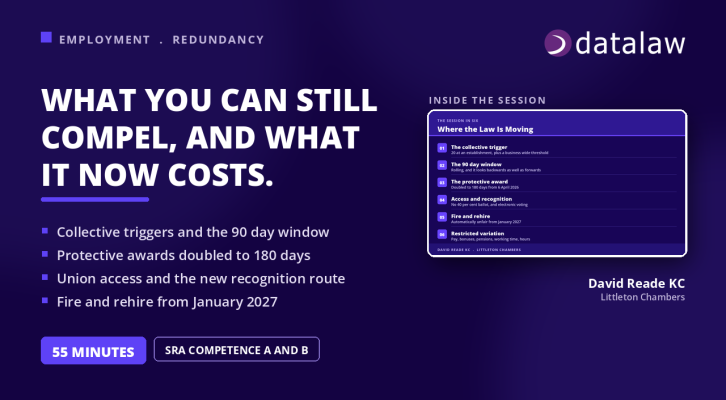
He starts with the collective redundancy trigger. Twenty or more at one establishment survives, but a second trigger is coming that looks at the business as a whole, which answers the problem the Woolworths litigation exposed and means every employer will need a rolling view of redundancies across the organisation in any ninety day window. The penalty for getting it wrong already doubled to 180 days' gross pay per employee in April 2026, with a further twenty five per cent available where the fire and rehire code is breached. He then turns to trade union access, live since 31 October 2026, and a recognition process stripped of its forty per cent ballot threshold, which he expects to put collective bargaining in front of employers who have never had to deal with it.
The heart of the session is fire and rehire. From January 2027 dismissing an employee to force through a restricted variation is automatically unfair, and restricted variation is drawn widely enough to catch pay, bonuses, pensions, working time and any change in hours at all. The only way out is proving financial difficulty going to the business's survival as a going concern, which, as he points out, asks a tribunal to do something it has spent forty years declining to do: second-guess a commercial decision. The questions from the floor are worth staying for, covering constructive dismissal, working under protest, and whether employers will simply fire and not rehire.
Key Takeaways
- The collective trigger: why establishment still matters, what the Woolworths litigation settled, and how a business wide threshold alongside it changes the question every employer has to ask.
- The rolling ninety day window, and why a single further redundancy today can pull the previous eighty nine days into scope.
- Exposure: the protective award doubled to 180 days from 6 April 2026, with a further twenty five per cent uplift where the fire and rehire code is not followed.
- Consultation across multiple sites: consulting locally while giving every group the national picture, and the changes to the HR1 notification.
- Trade union access from 31 October 2026, and a recognition route with the forty per cent ballot threshold removed, a ten per cent membership test and electronic ballots.
- Fire and rehire from January 2027: what counts as a restricted variation, the financial difficulties defence and how high it is set, and the separate fairness test for variations that are not restricted.





 Webinar Recording
 Webinar Slides
 17366 Users
 1139 Courses
 551 Reviews
