Andrew Rhodes of No.5 Chambers thinks AI is hitting the employment tribunal harder than any other jurisdiction, and his reason is structural. The tribunal was built for people without lawyers, the rules require parties to be on an equal footing, and employment law is complicated enough to defeat most of them. Free tools that will write a pleading are the obvious answer, and litigants in person are using them.
What arrives is rarely better. He opens with two amendment applications listed for the following day, one 80 pages and one 90, in a case already on its fourth preliminary hearing. Pleadings cite everything, run several times the length they need to, and frequently include causes of action the tribunal has no jurisdiction over. Worse, because the document was generated rather than written, the claimant often cannot explain what the case is about, so the judge cannot either. That means more preliminary hearings, more applications and longer bundles, in a system already listing into 2029 and 2030.
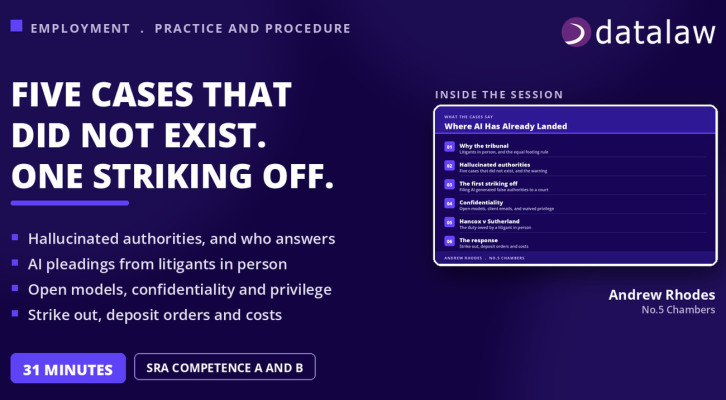
The other half is what it does to those who should know better. He works through Ayinde, where five cases cited to the court did not exist and Dame Victoria Sharp warned that AI carries risks as well as opportunities, the first striking off by the Solicitors Disciplinary Tribunal for filing AI generated false authorities, and Hancox v Sutherland, where the EAT set out what a litigant in person owes the court. He is also blunt about confidentiality: an open model trains on what you put into it, an immigration adviser who uploaded client emails and decision letters was held to have breached confidence and waived privilege, and clients need telling not to run your advice through ChatGPT.
Key Takeaways
- Why the tribunal is worse affected than other jurisdictions, and what the equal footing rule means when one side's case was generated rather than written.
- The regulatory line: Ayinde and the warning from Dame Victoria Sharp, the first striking off by the SDT for AI generated false authorities, and the judiciary position statement of 9 October 2026.
- Hallucinations are not only case law. Submissions of fact go wrong just as often, and an AI summary of a client's documents matches the underlying papers about half the time.
- Confidentiality and privilege: why an open model is not a safe place for client material, what happened when an adviser uploaded emails and decision letters, and why closed models matter.





 Webinar Recording
 17366 Users
 1139 Courses
 551 Reviews
